



Join Mago now!
Secure a spot on our waitlist.


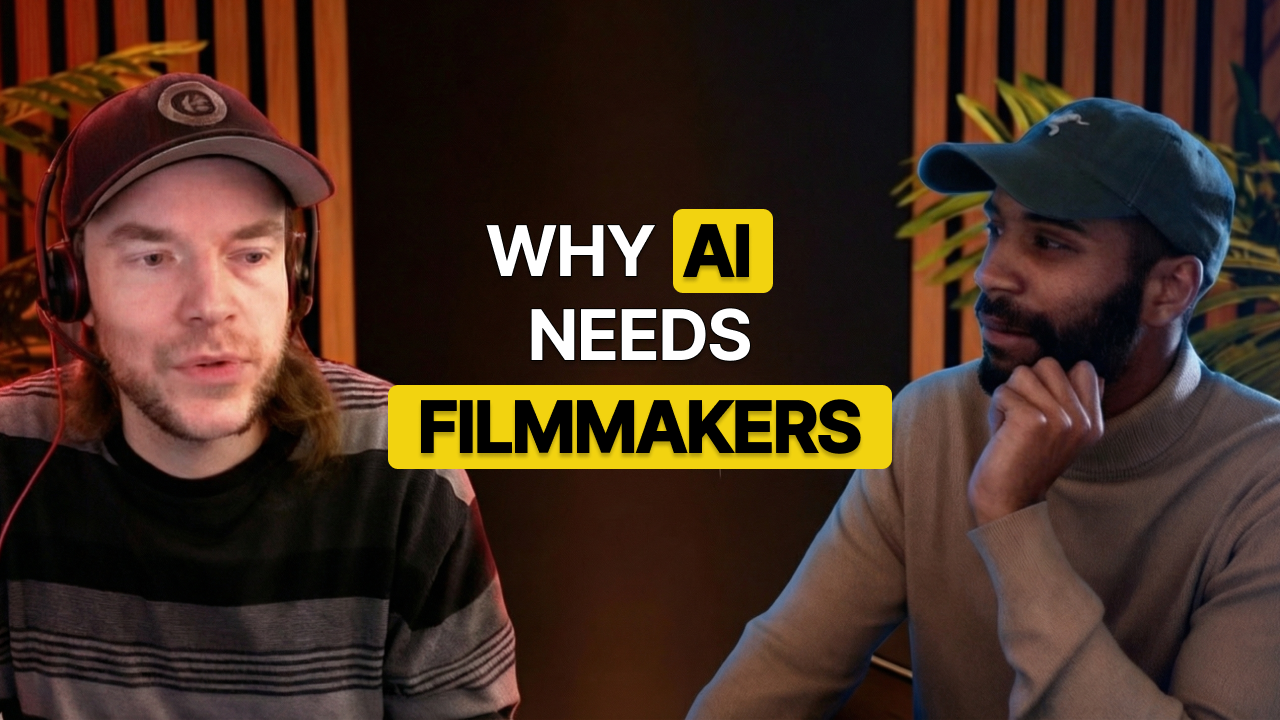
Video interview: Watch the full conversation here: https://www.youtube.com/watch?v=sCWdUEixaXs
Artificial intelligence is rapidly entering the world of filmmaking, but the most interesting conversations are no longer about tools. They are about authorship, control, narrative grammar, and what it truly means to make a film.
In this first episode of our long-form interview series, we sit down with Samuel, a Belgian filmmaker with over 20 years of experience in commercial and fiction filmmaking. An early adopter of Mago Studio and a key contributor to our creator program, Samuel brings a rare perspective. He is neither blindly enthusiastic nor dismissive of AI. Instead, he approaches it as a filmmaker first, using AI as a way to bridge production gaps while preserving cinematic language.
This conversation explores how AI can enable solo creators, why actors remain essential, how sound design sells reality, and why most AI films fail not because of technology, but because of a lack of craft.
Samuel begins by explaining the structural challenge of filmmaking in Belgium. Feature films often require budgets between €1.5M and €2.5M, and public funding heavily favors social dramas over genre films such as science fiction or fantasy.
Despite having written and submitted multiple dossiers over 13 years, only one project was financed. This limitation pushed him to explore whether AI could bridge the most expensive part of filmmaking: production.
Pre-production and post-production can already be handled by small teams or even solo creators. Production is where costs explode. AI, for Samuel, is not about replacing filmmaking, but about compressing production value without compromising narrative intent.
A key theme of the discussion is that filmmaking grammar has not changed. Screenwriting, dramaturgy, editing, pacing, and camera language remain exactly the same. AI does not invent a new cinematic language.
Samuel describes AI as comparable to the shift from analog to digital film. It is a technological evolution, not a conceptual revolution. The grammar of cinema still applies.
This is why many AI-generated films fail. They look impressive but lack narrative cohesion, emotional continuity, and intentional direction.
Samuel walks us through a concrete project: adapting a children’s book about a spider migrating due to climate change. The source material consisted of minimal watercolor illustrations and a short narrative.
The goal was to produce a three-minute animated preview to attract partners and broadcasters. The entire project was completed in ten days.

1. Source material immersion
Understanding the book, the author’s intent, and the educational mission behind it.
2.World building from limited references
Only one spider design and one landscape existed as watercolor hand drawn illustrations to the book. Everything else had to be invented.
3.Image generation and compositing
Backgrounds and characters were created and assembled using Nano Banana and Photoshop for rough composition.
4. Video generation as a camera
Grok Imagine model was used to animate scenes quickly at low resolution, focusing on motion, blocking, and pacing. Using Nano Bana’s images an input.
5. Creative upscaling as a film lab
Mago’s Creative Upscaler was used to remove AI artifacts and restore image coherence, transforming rough outputs into production-ready visuals.
6. Sound design and music generation
All audio was rebuilt from scratch using Mirelo AI sound tool capable of layering, dynamics, and narrative progression.
Samuel emphasizes that audio is what sells reality. Even when visual imperfections remain, correct sound design allows the audience to suspend disbelief.
One of the strongest statements in the interview is simple:
Actors do not perform motion. They perform e-motion.
AI struggles with long-term emotional consistency. While it can generate short clips convincingly, it cannot maintain a character’s psychological evolution across an entire feature film.
A character’s emotional state in scene 50 depends on what happened in scene 2. AI models lack persistent memory at that scale. This is why Samuel believes actors will remain central to filmmaking.
His preferred approach is video-to-video: filming real actors on simple sets, then using AI to transform environments, lighting, and aesthetics in post-production.
According to Samuel, the issue is not AI quality. It is intent.
AI has removed the cost barrier, but it has also removed friction. Unlimited generation leads to spectacle without meaning. High-end visuals created without narrative discipline produce what he calls “AI slop.”
Historically, high production value required time, money, and skill. Now, anyone can generate cinematic imagery instantly. The disconnect is that craft has not been learned.
Learning filmmaking still requires time. Just as musicians learn acoustic instruments before electric ones, filmmakers must understand camera language, editing grammar, and storytelling before relying on AI.
One of the most striking reflections in the conversation is this:
If AI can show anything, why does it mostly show what we have already seen?
Samuel argues that true cinema reveals the mundane in a way we have never perceived before. Spectacle alone is not enough. Meaning emerges from intention, not from visual excess.
AI should be used to serve a story that could already exist on paper. If a story works when read, film can add value. If it does not, AI will not save it.
Looking ahead, Samuel’s ambition is clear. He wants to create a full feature film using a video-to-video AI workflow.
The plan involves:
The goal is not to prove that AI can replace filmmaking, but that it can expand what small teams and solo creators are capable of producing.
This conversation is not about hype or fear. It is about responsibility, craft, and curiosity.
AI is neither the enemy nor the savior of cinema. It is a tool. And like any tool, its value depends on the hands that use it.
Filmmaking remains what it has always been: a human attempt to create meaning through time, image, and sound.
Mago is a video-to-video tool designed for filmmakers looking for real creative controls for each shot.
Try Mago now: https://www.mago.studio/
Secure a spot on our waitlist.


.svg)